Cookware that actually lasts: what I keep buying and what I quit

I've thrown out more pans than I'd like to admit — warped pancake makers, nonstick skillets shedding their coating into my eggs, a "lifetime" set that lasted two years. The cookware that survived isn't the prettiest or the most expensive. It's a short, boring list, and once you own it you basically stop buying pans.
The pitch from cookware brands is that you need a matching set — ten pieces, color-coordinated, the same logo on every lid. That's how you end up with three pans you use and seven that store. Buy individually, buy for longevity, and you'll spend less over a decade than one fancy set costs.
The pans that outlive everything: cast iron and carbon steel
If something in my kitchen will outlive me, it's the cast iron. A single cast iron skillet is maybe $20–30, takes a brutal sear, goes from stovetop to oven without a thought, and gets better with age as the seasoning builds. The catch is honest: it's heavy, it needs drying and a wipe of oil so it doesn't rust, and it's slow to change temperature. Those aren't flaws so much as the terms of the deal — accept them and the pan is genuinely forever.
For everyday cooking I reach for carbon steel pan more than anything else. It's the restaurant move: nearly as tough as cast iron, lighter, and it seasons into a slick semi-nonstick surface for eggs and fish. Same rule applies — dry it, oil it, don't leave tomato sauce simmering in it for an hour or you'll strip the seasoning. A carbon steel wok is the same story and it's the one pan that makes home stir-fry actually work, because thin metal screams up to heat fast. These pans don't wear out. They just need you to not abuse them.
Stainless clad is the workhorse you'll keep refilling around
Cast iron and carbon steel can't do everything — anything acidic, anything you want to deglaze into a pan sauce, anything where you need to see the fond. That's where a tri-ply stainless steel skillet earns its place. "Tri-ply" or "fully clad" means aluminum sandwiched in steel for even heat; a cheap stainless pan with a disc bottom warps and scorches in a ring. Spend here once and it lasts decades — no coating to fail, dishwasher-safe, oven-safe to any temperature.
The other clad piece worth owning is a stainless steel saucepan for rice, sauces, blanching, reducing. A 3-quart and an 8-quart stainless steel stockpot cover the rest of the wet cooking. Stainless has a learning curve — food sticks until you let the pan heat properly and add fat — but nothing about it degrades, which is the entire point of this article. It's the cookware equivalent of a tool you hand down.
The enameled Dutch oven: buy it once, skip the $400 one
A heavy enameled dutch oven is the braising, soup, no-knead-bread, deep-fry workhorse, and it genuinely lasts decades because the enamel doesn't peel like nonstick — it chips only if you bang it. Here's the honest part the brand ambassadors won't say: the $80 one and the $400 one cook nearly identically. You are paying the premium for the color, the name on the lid, and resale prestige. The cheaper enameled cast iron from a warehouse store or a solid mid-brand does the same job.
If you braise short ribs or bake bread weekly, fine, treat yourself. But for most people a mid-priced dutch oven is the smart buy, and the $320 you saved buys all the carbon steel and stainless above. Watch for a tight-fitting lid and stainless (not plastic) knob so it's oven-safe at any temperature. That's the only spec that matters.
What I quit buying
Nonstick. Not entirely — one cheap nonstick frying pan for eggs and pancakes is reasonable — but I quit treating it as durable cookware, because it isn't. The coating wears out in one to three years no matter the brand or the price, and a $200 nonstick pan dies on the same timeline as a $25 one. So I buy the $25 one, treat it as a consumable, never use metal utensils on it, never crank it past medium heat, and replace it when it stops releasing. Spending big on nonstick is spending big on something designed to fail.
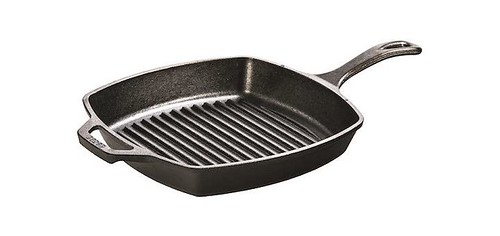
I also quit buying full sets, quit buying anything with rivets or handles that trap food and loosen over time, and quit single-purpose pans — the egg-poacher inserts, the pancake-ring pan, the panini press that lives in a cupboard. And I quit "lifetime warranty" nonstick marketing, which usually means they'll send you another pan that also fails, as long as you keep the receipt and pay shipping. A long-handled cast iron grill pan for stovetop searing earns its keep; the gimmicks don't.
The whole durable kitchen is maybe five pieces: a cast iron skillet, a carbon steel pan or wok, a clad stainless skillet and a saucepan, and an enameled Dutch oven, plus one cheap nonstick you accept will die. Buy those individually over a year, learn to dry and season the iron, and you've basically bought your last pans. Everything peeling in your cupboard right now was sold to you as durable. The stuff that actually lasts was sitting there cheap the whole time.
Ready to shop? Compare cast iron grill pan across stores → 📚 Or browse cooking courses & recipe books in Digital Goods →